
Why SEO vs Google Ads in Malaysia is a live question
If you run a business in Malaysia today, the debate around SEO vs Google Ads in Malaysia is not academic. It is budget, pipeline, hiring, and growth. Malaysia’s internet penetration was about 98.0 percent at the end of 2025, with 35.4 million internet users and 44.0 million mobile connections, while DOSM’s latest household survey reported that 98.0 percent of individuals used the internet in 2024 and 93.0 percent relied on the internet to search for information on goods and services. In other words, your buyers are online, they are searching, and for most categories, digital discovery is already part of the buying journey.
That is why this question shows up in so many boardrooms and WhatsApp groups: “Should we invest in SEO, or should we just run Google Ads?” It sounds like an either-or decision. In practice, it rarely is. But before we get to the “both” answer that consultants love to give, it helps to understand why the question feels so urgent in Malaysia right now. E-commerce transaction income in Malaysia reached RM1,184.1 billion in 2023, and 72.7 percent of establishments had a web presence that same year. More companies are online, more buyers are comparing options digitally, and more categories are crowded than they were a few years ago.
There is another reason this debate is so specifically Malaysian. Search here still matters a lot because Google overwhelmingly dominates the market. StatCounter’s Malaysia data for May 2026 shows Google with 93.03 percent search engine market share, far ahead of Bing at 4.14 percent and Yahoo at 1.73 percent. So when Malaysian SMEs ask about search demand, they are usually talking about Google demand, not some abstract search layer.
And yet the buyer journey is also getting messier. A prospect may discover a brand on TikTok, compare suppliers on Google, click a paid ad, then revisit later through an organic result or a branded search. Even Google’s own Search documentation now includes guidance for AI Overviews and AI Mode, and says that SEO best practices still matter because those generative features are rooted in core Search ranking and quality systems. So the old lazy framing — “SEO is old, Ads are modern” — simply does not hold up. Search has expanded, not disappeared.
For Malaysian SMEs, the real issue is not “Which channel is better in theory?” The real issue is: Which channel matches your timeline, margin, market maturity, and expansion plan? If you need leads next week, that answer looks very different from a company trying to reduce acquisition costs over the next eighteen months.
If you are a local clinic in Petaling Jaya, the playbook is different from a B2B manufacturer in Johor trying to win both Malaysia and Singapore. That is exactly where the SEO vs Google Ads in Malaysia discussion becomes useful instead of generic.
What SEO does best in the Malaysian market
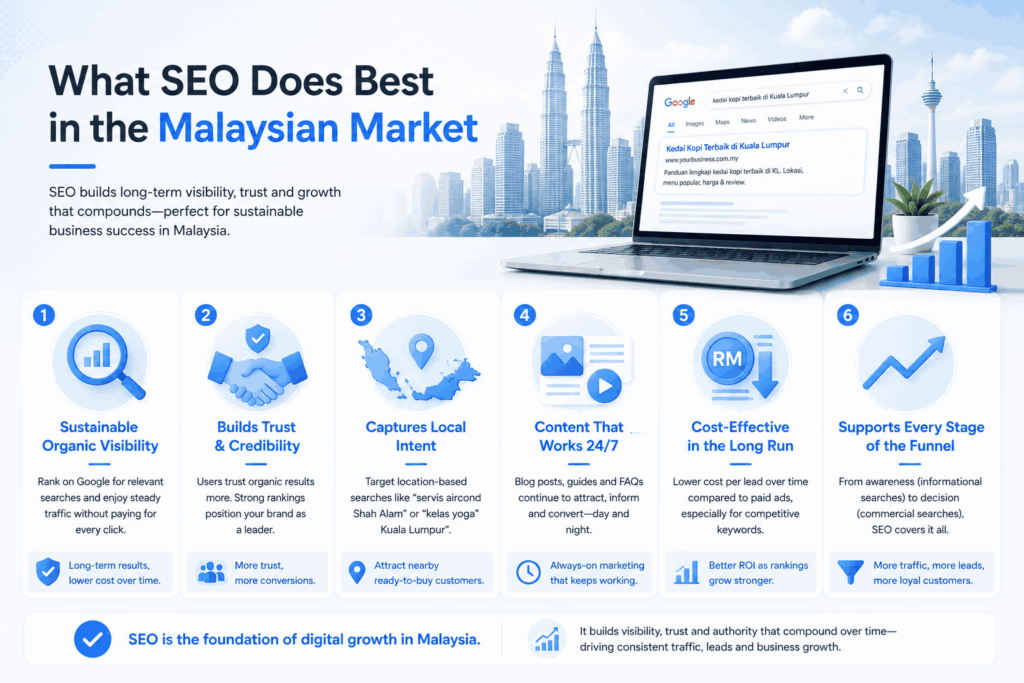
Let’s start with SEO, because many businesses misunderstand what they are actually buying. Google’s SEO Starter Guide describes SEO as helping search engines understand your content and helping users find your site and decide whether to visit it through search.
Google also makes two points that matter here: there is no guarantee that any particular site will be added to the index, and no one can pay Google to rank organically. Advertising with Google does not affect your site’s presence in organic search results. That means SEO is not a shortcut, and it is definitely not “buy more ads, rank higher organically.” That idea is simply wrong.
What SEO does buy you is durable visibility. Once your pages rank for meaningful queries, every click is not billed like a media charge. Google explicitly says it costs nothing to appear in organic results, even though the work required to earn and maintain those results certainly is not free. You are paying for strategy, content, technical fixes, UX, analysis, and time — not for each impression or click. For many Malaysian SMEs, especially those in services, education, healthcare, SaaS, property, industrial supply, and niche B2B categories, that compounding effect is the biggest reason SEO remains attractive.
SEO is especially strong when your buyers research before they buy. Think about searches like “best accounting software for malaysia sme,” “b2b warehouse racking supplier malaysia,” “orthodontist subang jaya,” or “how to register trademark malaysia.” These are not random clicks. They are signals of intent, often high-consideration intent.
Good SEO lets your business show up repeatedly across problem-aware, solution-aware, and brand-aware searches. That matters because organic visibility often builds trust before the sales conversation starts. Google’s people-first content guidance makes the logic clear: its systems prioritize helpful, reliable information created to benefit people, not content built merely to manipulate rankings.
In Malaysia, SEO also performs well because mobile behavior is now the default, not the exception. Nearly every household has access to mobile phones, internet usage is high in both urban and rural areas, and Google’s page experience guidance says site owners should think beyond one technical metric and ensure pages are mobile-friendly, secure, and easy to use.
That matters for local SMEs that still treat their site as a digital brochure. A pretty homepage is not a search strategy. If your pages are slow, generic, hard to navigate, or weak on service detail, SEO will struggle no matter how strong your brand story sounds in a pitch deck.
This is where local execution often falls apart. Many Malaysian companies say they “did SEO” when what they actually did was sprinkle keywords onto a homepage and publish three bland blog posts. Google’s guidance is much stricter than that. Helpful content should bring original information, substantial value, clear expertise, and a satisfying experience.
It should also make clear who created it and why it exists. If you are writing about logistics, legal, healthcare, finance, engineering, or export regulations, vague outsourced copy is not enough. In those categories, strong expertise and trust signals matter even more.
Another advantage of SEO in Malaysia is locality. A well-optimized local service business can show up for city, district, and intent-rich searches over time, which is valuable when users are looking for something nearby or serviceable in-market. For companies growing across multiple regions or languages, Google’s multilingual documentation is also highly relevant: it recommends different URLs for different language versions and using hreflang or equivalent methods to help Google serve the right localized page.
For Malaysian brands serving English and Bahasa Melayu audiences, and perhaps expanding into Singapore or Indonesia, that guidance strongly suggests that localized pages outperform one generic catch-all page in the long run. That is a strategic inference based on Google’s localization recommendations.
SEO is also more future-proof than many people assume. Google’s guidance on generative AI features says SEO remains relevant for AI Overviews and AI Mode because those experiences are rooted in core Search ranking and quality systems.
So if a leadership team is hesitating because “AI will replace SEO anyway,” the official guidance points the other way: strong SEO fundamentals still matter. Helpful content, technical clarity, strong page experience, and topical relevance do not become less important in an AI-shaped search environment; if anything, they become more important.
Now for the part many agencies avoid saying plainly: SEO is slow. Ara Semangat Asia’s own SEO page says results may take four to six months to begin showing, and around a year may be needed to implement and mature the full set of on-page and off-page improvements.
That timing unlocks the core truth in the SEO vs Google Ads in Malaysia debate: SEO is not ideal when the business problem is immediate lead scarcity. If you need sales this quarter because inventory is moving too slowly, or because a new branch just opened in Penang, SEO should still be built — but it is probably not enough by itself.
So when is SEO the better primary bet? Usually when the business has one or more of these characteristics: ongoing search demand, a clear service or knowledge proposition, a website that can be improved, margins that reward lower long-term acquisition cost, and the patience to invest beyond a single quarter. If your leadership team wants compounding visibility, stronger branded demand, and less dependence on paying for every click forever, SEO is hard to ignore.
Where Google Ads pulls ahead
Now let’s talk about Google Ads, because this is where many Malaysian SMEs feel immediate relief. Google’s own Ads documentation is straightforward: Search campaigns can help you get more sales, leads, or website traffic, and they give you access to highly relevant targeting by reaching people actively searching for your specific products and services.
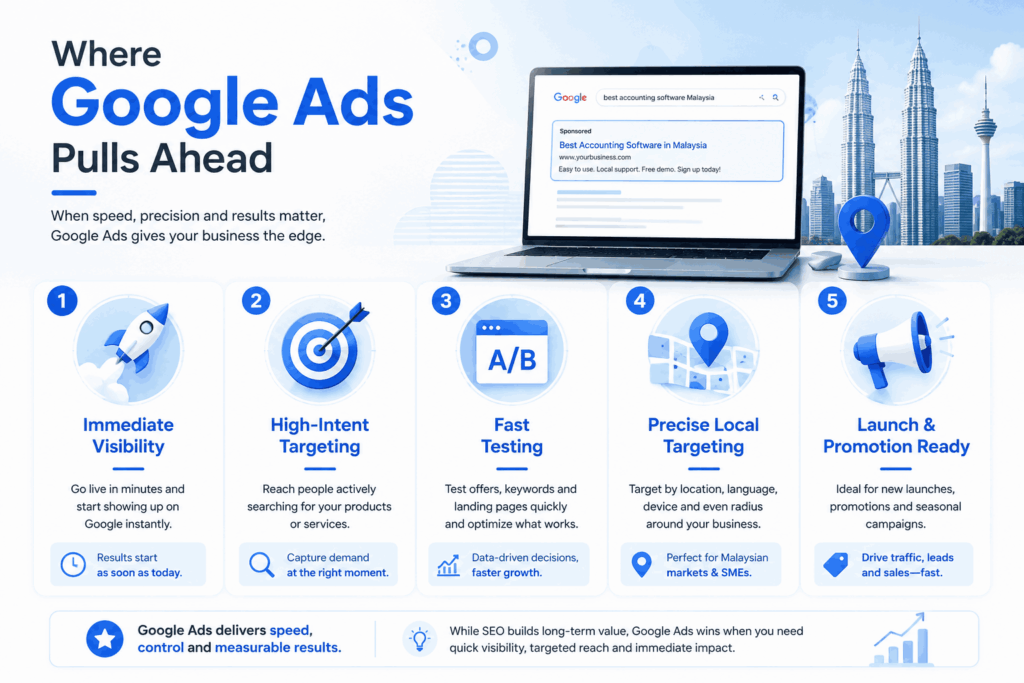
That last point is the real superpower. Paid search captures demand that already exists. It does not wait for Google to slowly evaluate and elevate your organic content over months. It can put you into the conversation now.
That speed is why Google Ads usually wins when the problem is urgent. Launching a new product? Opening a clinic branch? Running a Raya promotion? Testing a new city? Wanting to validate demand before rebuilding an entire site? Ads are built for that.
Ara Semangat Asia’s PPC page frames the value clearly: paid search can obtain high-quality traffic rapidly, support product awareness, and provide measurable outcomes. Google Ads also lets you choose campaign objectives such as sales, leads, or website traffic, which makes the platform operationally aligned with business goals rather than just awareness metrics.
Google Ads is also stronger when you need precision. You can target countries, cities, territories, or even a radius around a location. For Malaysian brands with cross-border ambitions, that matters more than people realize. A company based in Kuala Lumpur can target Malaysia only, or expand to Singapore, Indonesia, or specific city clusters once fulfillment and compliance are ready.
Google Ads documentation specifically notes that advertisers can target entire countries, areas within a country, or a radius around a location, and that location targeting can also be refined as an optimization tool to concentrate spend where performance is strongest.
This location control is a major advantage in Southeast Asia. Let’s say you manufacture industrial parts in Johor and want to win Malaysian search demand while gradually testing Singapore buyers. SEO can support that expansion with localized content over time, but Google Ads can test it almost immediately. You can isolate geographies, monitor lead quality, and avoid building a full localization structure before you know the commercial potential. That is not a reason to skip SEO. It is a reason to use paid search to de-risk market entry.
Measurement is the other big reason Google Ads often gets budget first. Paid media is not automatically better because it is paid; it is often easier to read because attribution is closer to the click. Google Ads gives clear visibility into impressions, clicks, CTR, conversions, and bidding behavior.
Google defines CTR plainly as clicks divided by impressions, and Smart Bidding uses Google AI to optimize for conversions or conversion value in each auction. If you set up tracking properly, you can tell a manager pretty quickly whether a campaign is producing leads, how much they cost, and which keyword or geography is doing the work.
And yes, Google’s automation can be useful — when the underlying setup is clean. Smart Bidding can optimize for conversions or conversion value, and responsive search ads can dynamically mix and match headlines and descriptions to improve relevance. Google reports that advertisers who improve responsive search ad strength from “Poor” to “Excellent” find 15 percent more clicks and conversions on average, and adding a second responsive search ad can lift conversions at a similar cost per conversion. These are meaningful levers for advertisers who already have decent conversion tracking and landing-page relevance.
But here is the reality check: Google Ads is fast, not magical. If your landing page is weak, the campaign can still fail very efficiently. Google’s own best-practice material says your landing pages should be highly relevant to your keywords because that can improve Quality Score, lower CPC, and improve ad rank.
So if a Malaysian SME sends paid traffic to a vague homepage with no offer, slow load time, and no clear conversion path, the problem is not “Google Ads doesn’t work.” The problem is that the business paid to expose a weak user journey faster.
There is another common pitfall, and it matters a lot for budget-sensitive SMEs: misunderstanding spend control. Google Ads allows you to set an average daily budget and edit it at any time. However, Google also states that for most campaigns, the daily spending limit can be up to two times the average daily budget on a given day, while monthly spend is capped at 30.4 times the average daily budget. That means a campaign set at RM100 per day can, under normal system behavior, spend up to the equivalent of RM200 on a higher-traffic day. If the finance team expects a hard daily ceiling, that misunderstanding can create unnecessary panic.
So when does Google Ads deserve priority in the SEO vs Google Ads in Malaysia decision? Usually when speed matters, when the offer is already conversion-ready, when the business needs market feedback quickly, or when keyword competition is so intense that waiting only on SEO would be commercially expensive. If you need leads now, Ads is usually the more practical lever. If you need learning now, Ads is often the better diagnostic tool too.
How Malaysian SMEs should decide
The simplest way to choose is to stop thinking in channels first and start thinking in business conditions first.
If your website is brand new, your domain has little authority, and you need inquiries within the next sixty to ninety days, Google Ads should usually lead. Not because SEO is unimportant, but because Google’s own guidance and Ara Semangat Asia’s own SEO FAQ both point to the same reality: SEO takes time, while Search campaigns can immediately target active demand. In that situation, the smart move is often to launch paid search while building the SEO foundation in parallel.
If you are an established SME with a decent website and recurring search demand, SEO becomes more attractive as a primary growth asset. This is especially true if the sales cycle includes research, comparison, or repeated category searches. A Malaysian B2B software firm, education provider, legal practice, dental group, specialist manufacturer, or logistics company may benefit far more from a content-and-technical SEO engine than from trying to buy every click forever. Organic visibility is slower to build, but it can steadily reduce dependence on paid acquisition over time.
If your market is highly seasonal or promotion-driven, Ads often takes the lead. Think of Hari Raya retail pushes, school-intake campaigns, year-end inventory clearance, event marketing, travel packages, or property launches. Those are moments when timing matters more than long-form compounding. Google Ads lets you turn campaigns on, control geography, test messaging, and align spend to commercial windows. SEO can support these efforts, but it is rarely the only answer when the selling season is short.
If your biggest issue is trust, not traffic, SEO often punches above its weight. Why? Because strong organic content can answer doubts before a sales rep ever gets involved. Pricing pages, comparison pages, use cases, FAQs, founder expertise, reviews, and service-area pages can all reduce friction. Google’s people-first content guidance repeatedly emphasizes originality, completeness, expertise, trust, and clarity about who created the content. That gives businesses a playbook for building organic credibility in categories where buyers are cautious.
If your business is expanding beyond Malaysia, ask a different question: do you need demand validation first, or do you already know demand exists and now want long-term visibility? If validation is the immediate need, Google Ads usually gets the first move because you can target specific countries or locations and monitor response fast. If long-term visibility is the next phase, SEO should expand with localized pages, suitable language versions, and proper signaling so Google can serve the right variant to the right market. Google’s documentation on multilingual and multi-regional sites strongly supports this staged approach.
A final filter is internal capability. Google Search Central explicitly warns that an irresponsible SEO can damage a site and reputation, and says businesses should evaluate SEO providers carefully, especially around methods, expected timelines, and compliance with Search Essentials. The same logic applies to paid search, even if Google phrases it differently. A sloppy campaign setup can waste a lot of money fast. So the real question is not just channel choice; it is channel readiness. Do you have tracking? Relevant landing pages? Strong offer-market fit? Someone who can interpret performance honestly? Without those, both SEO and Ads underperform — just in different ways.
The strongest play is usually both
Here is the consultant answer, but this time with fewer clichés: for most serious businesses, the smartest answer to SEO vs Google Ads in Malaysia is not “pick one forever.” It is “sequence them properly, then integrate them.” Google itself frames Search, Performance Max, and Smart Bidding as complementary tools, and its Search documentation also shows how Search Console and Google Analytics can be used together to understand organic traffic and attribute conversions. The point is not platform worship. The point is that search data becomes more powerful when your teams stop working in silos.
A strong blended strategy often looks like this. Use Google Ads first to validate commercial keywords, messaging angles, geographies, and landing-page intent. Once you know which themes pull qualified leads — not merely cheap clicks — build durable SEO assets around them. Then let SEO reduce your long-term dependency on buying traffic for every important query. In practical terms, if paid search reveals that “custom warehouse racking malaysia” converts much better than a broader phrase like “storage solutions malaysia,” that insight should influence your SEO information architecture, content briefs, and landing-page priorities. That is a strategic inference, but it is grounded in the fact that both channels are query-driven and both depend on relevance between search intent and page experience.
There is also a budget logic here that many SMEs miss. SEO tends to improve resilience; Google Ads improves responsiveness. Resilience means you build a traffic base that does not disappear the moment media spend pauses. Responsiveness means you can scale visibility up or down quickly when launches, promotions, or geography tests require it. A business that uses only SEO may move too slowly. A business that uses only Ads may remain permanently rent-dependent. Blending the two reduces the weaknesses of both.
This integration becomes even more valuable in cross-border work. Ara Semangat Asia’s own positioning emphasizes digital innovation and integrated campaigns, and its site highlights both SEO and PPC alongside website development. That combination actually matches what search platforms now reward. If a Malaysian brand wants to sell into multiple Southeast Asian markets, it often needs synchronized work across paid search, localized content, landing pages, and technical structure. Google’s multilingual guidance and location-targeting controls make that operationally possible; the business challenge is usually organizational discipline, not platform capability.
So yes, “do both” is often the right call. But “do both” only works if each channel has a job. SEO should own long-term discoverability, trust, and compounding non-paid acquisition. Google Ads should own speed, testing, launch support, and controlled demand capture. Once you assign those roles clearly, the argument becomes much less emotional and much more commercial.
Suggested internal and external links
For internal linking on ASC Group’s site, the most natural companion pages for this article are Ara Semangat Asia’s Search Engine Optimization service page, Pay Per Click Marketing page, and Website Design & Development page. A fourth optional internal reference, especially for the discovery-angle discussion, is the blog post Social Media is the New Search Engine – How TikTok, Instagram & YouTube Are Changing Brand Discovery.
For trusted external references, good editorial choices include Google Search Central’s SEO Starter Guide, Google Ads Help on Search campaigns, DOSM’s Malaysia Digital Economy release, DataReportal’s Malaysia digital report, and StatCounter’s Malaysia search engine market share page. These cover search fundamentals, paid search mechanics, national digital adoption, and the local search landscape.
Final verdict on SEO vs Google Ads in Malaysia
So, what is the final answer on SEO vs Google Ads in Malaysia?
If you need fast leads, want tight geographic control, or need to test market demand quickly, Google Ads usually wins first. It is faster, easier to measure in the short term, and better suited to launches, promotions, and urgency. If you want compounding visibility, stronger trust, and lower dependence on paying for every customer interaction, SEO is the better long-term asset. Google’s own documentation makes it clear that organic visibility cannot be bought directly, that helpful people-first content still matters, and that those fundamentals remain relevant even in generative search experiences.
For most Malaysian SMEs and regional growth brands, the real winner is not a channel. It is a sequence. Start with the channel that matches the business problem in front of you. If the problem is urgency, let Google Ads lead while the SEO groundwork is built properly. If the problem is long-term efficiency and market authority, let SEO take a bigger share while paid search fills gaps and protects commercial moments. In a market where internet adoption is near universal, people routinely search online for goods and services, and Google still dominates search behavior, ignoring either channel is usually the more expensive mistake.
The blunt version? If your team says SEO will solve next month’s sales problem, that is usually not right. If your team says Google Ads alone is enough for the next three years, that is also not right. The smarter strategy is to treat SEO vs Google Ads in Malaysia as a portfolio decision: Ads for speed, SEO for equity, and both tied together by solid landing pages, honest measurement, and market-specific localization. That is how Malaysian brands stop chasing traffic and start building real search-driven growth.