
If you have asked three agencies about SEO Cost in Malaysia and received three wildly different quotations, you are not imagining things. In the current market, one provider may pitch entry-level work around RM900 to RM1,700 a month, while another may quote RM5,000, RM8,000, or more for broader technical, content, and authority-building work. Publicly available Malaysian pricing pages show that spread clearly, which is why business owners often feel they are comparing apples, durians, and maybe one mystery fruit as well. The important takeaway is this: there is no single “official” SEO price in Malaysia, only market ranges shaped by scope, competition, website condition, and business ambition.
That pricing question matters because Malaysia is already a highly digital, highly connected market. DataReportal reports 35.4 million internet users in Malaysia at the end of 2025, equal to 98.0% internet penetration, while social media user identities reached 30.7 million, or 85.0% of the population. At the same time, DOSM reports that ICT and e-commerce contributed 23.4% of Malaysia’s economy in 2024, equivalent to RM451.3 billion, and that 72.7% of establishments had web presence in 2023. In plain English, your prospects are online, your competitors are online, and the cost of invisibility is rising.
Search behavior in Malaysia is still overwhelmingly Google-led. Statcounter’s Malaysia data shows Google held about 93% of the search engine market in May 2026. That does not mean brands can ignore social search or AI-assisted discovery, but it does mean most Malaysian SEO investment still needs to be built for Google’s ecosystem first: search results, local pack visibility, search snippets, and site performance.
This is also why a serious article about SEO Cost in Malaysia cannot stop at quoting package prices. Price only becomes meaningful when you connect it to what a business is actually buying: technical fixes, information architecture, content production, local SEO, reporting, conversion improvements, developer coordination, and sometimes multilingual or cross-border execution.
Google’s own documentation frames SEO as making it easier for search engines to crawl, index, and understand content, while helping users discover it and decide whether to visit. That is operational work, not magic.
What SEO Cost in Malaysia actually looks like
If we synthesize the most recent public pricing guides from Malaysian agencies, a practical current answer to SEO Cost in Malaysia looks like this: many SMEs will encounter monthly retainers in the RM1,500 to RM6,000 range, while the broader market can stretch from about RM900 to RM10,000+ depending on provider, competitiveness, and scope. That is not an official industry tariff; it is a directional market reading based on multiple Malaysian agency pages published or updated in 2025 and 2026.
Monthly retainers remain the dominant model. ZenWeb’s 2026 guide lists a typical monthly retainer at RM1,500 to RM6,000, while MediaPlus Digital places monthly retainer pricing at RM1,500 to RM9,000, WebServer groups basic to premium monthly packages at RM1,500 to RM12,000+, and VeecoTech says Malaysia SEO services typically range from RM900 to RM10,000+ per month. This is exactly why a quote with no scope attached tells you almost nothing. “RM2,000 a month” can mean a real growth program, or it can mean a few superficial edits and one recycled report.
Project pricing is also common, especially when a business needs an SEO audit, migration support, content restructuring, tracking setup, or recovery work after a redesign. Published Malaysian ranges vary widely here too: ZenWeb cites RM2,000 to RM8,000 for one-off projects, while BThrust says project-based SEO can range from RM2,000 up to RM30,000 depending on scope, and MediaPlus Digital places larger project work at RM4,000 to RM20,000+. For a business launching a new website or rebuilding a broken one, this model can make sense before shifting into a retainer.
Hourly consulting exists, but it is usually best for specific guidance rather than end-to-end delivery. Public local guides place Malaysian hourly consulting around RM150 to RM500 per hour, while some onsite SEO specialists are quoted higher in certain cases. That can be useful if your team already has writers, developers, and a marketing lead, and only needs senior strategic direction, audits, QA, or monthly coaching. It is much less useful if you expect the consultant to also execute everything.
Local SEO deserves its own mention because its cost structure is often lower than national or e-commerce SEO. ZenWeb’s recent local SEO guide suggests many single-location Malaysian SMEs pay roughly RM800 to RM3,500 per month for local SEO, depending on competitiveness and deliverables. That fits businesses like clinics, accountants, cafés, showrooms, dental practices, training centres, or service-area brands that mostly need Google Business Profile optimization, local landing pages, citations, reviews, and “near me” visibility rather than large-scale nationwide content publishing.
What about the suspiciously cheap packages? Some current Malaysian providers openly warn that very low monthly offers often come with extremely limited scope or heavily automated work. ZenWeb, for example, explicitly warns that below-RM800 packages tend to be low-scope or AI-spam-heavy. That is one agency’s interpretation, so it should not be treated as a universal law. Still, the broader logic holds: when pricing drops too far below market, something usually gets cut—content quality, technical work, reporting integrity, link quality, or human attention.
An equally important nuance is that most public pricing pages are self-published by agencies. They are useful for directional benchmarking, but they are not neutral academic studies. The safest reading is to use them as market signals, then compare them against broader industry survey patterns. Ahrefs’ pricing survey shows monthly retainers are the most common pricing model in SEO globally, with the US$501–US$1,000 retainer band being especially common in its sample, which supports the idea that recurring retainers are the standard commercial structure rather than an odd Malaysian exception.
What makes SEO Cost in Malaysia go up or down
The first driver is competitive intensity. Ranking a modest local plumbing company in one district is not the same job as ranking a national insurance brand, an aesthetic clinic, a lawyer, a property developer, or a finance comparison site. Competitive SERPs need deeper keyword strategy, stronger content, stronger authority signals, more pages, better internal linking, stricter technical QA, and more patience. That is why the same agency might quote RM1,800 to one client and RM8,000 to another without being inconsistent.
The second driver is website condition. If a site has weak structure, duplicate pages, slow templates, messy metadata, poor internal linking, no measurement setup, and thin category pages, the provider is not just “doing SEO.” They are cleaning up years of invisible debt. Ara Semangat Asia’s own SEO page emphasizes full-site reviews, structure, usability, on-site and off-site optimization, and analytics support, while its e-commerce page highlights SEO-friendly structure in website development. In practice, businesses with weak foundations usually pay more either upfront through a project phase or gradually through a heavier retainer.
The third driver is content depth and frequency. Google’s documentation repeatedly emphasizes helpful, reliable, people-first content, and its Search Essentials and spam policies make clear that manipulative or low-quality tactics can hurt visibility. So when an agency proposes a price, ask a simple question: how much original, useful, localized content is actually included every month, and who is accountable for it? A package with no editorial process may look cheaper, but it can become expensive very quickly if it produces pages that do not rank, do not convert, or attract the wrong traffic.
The fourth driver is local versus national versus regional scope. A Malaysian SME targeting “dentist in Bangsar” is dealing with a different SEO universe from a B2B manufacturer targeting leads in Malaysia, Singapore, and Indonesia. Google’s multilingual and international documentation recommends distinct URLs for language versions and the use of hreflang for localized variations, which means cross-border SEO usually requires more technical planning, more content variants, and more QA. In Southeast Asia, that may also mean English plus Bahasa Malaysia, Chinese, Indonesian, or Thai workflows depending on the market. That additional complexity directly affects SEO Cost in Malaysia for brands with regional growth plans.
The fifth driver is business type. Service businesses often need local pages, trust content, and lead-gen landing pages. E-commerce brands need category optimization, faceted navigation control, product schema, internal linking, seasonal campaigns, and content that supports commercial intent at scale. DOSM’s digital economy release and the e-Conomy SEA 2025 material both point to a large and still-growing digital commerce environment, while Bernama’s summary of the e-Conomy SEA 2025 report says Malaysia was the fastest-growing digital economy in Southeast Asia and on track to reach US$39 billion GMV in 2025. Bigger digital commerce opportunity generally means fiercer organic competition.
The sixth driver is reporting, transparency, and team composition. A serious SEO program increasingly requires Search Console analysis, GA4 reporting, content briefs, developer QA, and competitive monitoring. Google Search Console itself is free, but the workflow around it is not. Tooling also adds cost: Ahrefs’ official pricing starts at US$29 for Starter and US$129 for Lite, while Semrush’s SEO toolkit pricing starts around US$117.33 per month billed annually. Good agencies absorb or allocate that tooling cost; cheap providers often avoid it, which limits the depth of research they can do.
What each pricing tier should include
A useful way to think about SEO Cost in Malaysia is not by package names like “Silver,” “Gold,” or “Diamond,” but by expected capability.
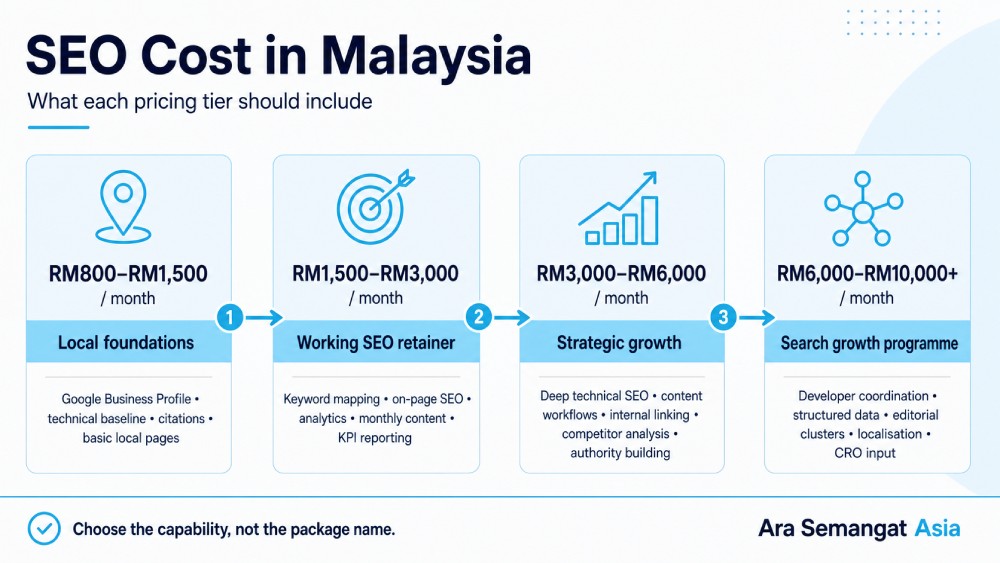
At the lower end, usually around RM800 to RM1,500 per month, you should expect highly focused local SEO or foundational support rather than an all-inclusive growth engine. This tier often suits a single-location SME with a relatively small site and limited competition. The work may include Google Business Profile cleanup, metadata improvements, a technical baseline audit, citation consistency, basic local landing pages, and monthly reporting. If a provider at this price promises national rankings, link outreach, frequent content creation, CRO, and technical development support all at once, the promise is probably doing more work than the team.
In the RM1,500 to RM3,000 range, many Malaysian SMEs begin to access what might fairly be called a working SEO retainer. Public local pricing pages repeatedly cluster here for legitimate SME programs. At this level, you should normally expect keyword mapping, on-page optimization, Search Console/analytics oversight, some monthly content or content optimization, local SEO support if relevant, and regular reporting tied to business KPIs. This is the tier where service businesses, education brands, franchise outlets, and many B2B SMEs can begin to build momentum if they already have a decent website and internal cooperation.
In the RM3,000 to RM6,000 band, the program should look more strategic and more substantial. This is where competitive SMEs, brands with large service catalogs, or smaller e-commerce operators often sit. The difference should not just be “more keywords.” It should mean deeper technical auditing, stronger publishing workflows, better internal linking, better page templates, more consistent content production, stronger competitor analysis, and often some authority-building or digital PR activity. If an agency charges within this range but still talks mostly about meta tags and ranking reports, the scope may be underbuilt.
Once you reach RM6,000 to RM10,000+ per month, the conversation should usually shift from “SEO package” to “search growth program.” This is more common for national brands, complex e-commerce businesses, multi-location groups, brands in tough verticals, or firms doing multilingual and cross-border work. At that point, the SEO team may need developer coordination, structured data implementation, editorial planning across multiple clusters, localized content versions, migration support, CRO input, and stakeholder reporting for leadership teams. The price is higher because the organizational burden is higher, not just because the agency wants a premium logo on the proposal.
One more practical note: local SEO and full-site SEO are not interchangeable. Google Business Profile is free to create, and Google explicitly says complete and accurate profile information helps local visibility. So if your business only needs stronger Maps and local pack visibility, paying for a national content machine may be unnecessary. On the other hand, if you are trying to rank category pages, knowledge content, and service pages across multiple states or countries, a cheap “local SEO” plan will not solve the real problem.
Many Malaysian brands discover that SEO cost, PPC cost, and website cost should be planned together rather than treated as three unrelated decisions. Ara Semangat Asia’s own SEO service position SEO, PPC, analytics, and SEO-friendly web structure as connected levers, which is the right way to think about total search investment.
How Malaysian SMEs should budget and measure ROI
For most SMEs, the smartest question is not “What is the cheapest SEO Cost in Malaysia?” but “What level of investment matches my commercial reality?” A small clinic with one location should not budget like a national e-commerce brand. A niche B2B manufacturer should not copy a beauty retail playbook. A Kuala Lumpur service business may win with a leaner budget if it owns a clear niche and strong local trust signals; a regional brand targeting multiple markets, multiple languages, and broad non-brand demand will almost always need more.
A practical budgeting approach for SMEs often looks like this. If you are pre-growth and mostly need local discoverability, start with local SEO plus page improvements. If you already have demand and a working website, invest in an RM1,500 to RM3,000 retainer that includes meaningful content and technical maintenance. If search is becoming a core acquisition channel, move closer to RM3,000 to RM6,000 and demand a real strategy, not just task lists. If you are scaling across products, locations, or countries, expect RM6,000+ because you are no longer buying simple optimization; you are funding search operations.
Businesses should also compare agency cost with in-house cost honestly. Jobstreet’s salary guide places the average monthly salary for search engine optimisation specialists in Malaysia around RM3,800 to RM6,300, and Indeed reports an average around RM5,299 per month. That is before recruitment, management time, employer costs, tools, content support, design help, and developer bandwidth. In other words, even when agency retainers look expensive, they are often cheaper than building a capable in-house function too early.
Measurement is where many SEO engagements either become credible or collapse. Google Search Console is the baseline: it shows the queries driving impressions and clicks, your indexed pages, and technical issues detected by Google. A serious SEO partner should tie those metrics to business outcomes: qualified leads, booked calls, store visits, demo requests, category revenue, or assisted conversions. Rankings alone are too shallow. If your brand ranks for the wrong keywords, traffic can rise while pipeline stays flat.
Timing matters too. Google’s SEO Starter Guide says some changes can take effect in hours while others may take several months, and it advises waiting a few weeks to assess whether work had beneficial effects in search results. That does not mean “SEO takes forever,” but it does mean any provider promising dramatic page-one results in 30 days for competitive terms should trigger skepticism. In Malaysia as elsewhere, SEO is a compounding channel, not a vending machine.
A sensible ROI model for Malaysian SMEs is brutally straightforward. Estimate the value of one qualified lead or one sale. Estimate how many additional qualified visits or conversions improved search visibility could produce. Then ask whether the retainer is economically justified over six to twelve months, not two weeks. This longer view matters because Google also notes that it does not accept payment to crawl more frequently or rank pages higher, which means results come from relevance, quality, technical execution, and time—not from back-channel shortcuts.
How to avoid overpaying or buying the wrong package
The first red flag is guaranteed rankings. If an agency guarantees page-one placement for competitive commercial terms without qualification, that should raise eyebrows immediately. Google is explicit that it does not accept payment to crawl a site more frequently or rank it higher. A provider can influence the probability of better performance through sound SEO work, but no legitimate agency controls Google’s ranking systems.
The second red flag is vague deliverables. “20 keywords,” “monthly submission,” or “SEO maintenance” sounds neat in a proposal, but those phrases are almost meaningless unless you know what actual work sits underneath them. Which pages will be optimized? How many content pieces are included? Will someone handle technical tickets with your developer? Is schema involved? Are internal links being audited? Are reports tied to conversions? In the Malaysian market, many price differences come down to depth of execution, so vague scope hides risk.
The third red flag is cheap authority-building that smells like manipulation. Google’s spam policies warn that deceptive tactics can lead to reduced rankings or omission from search results. If a provider cannot explain where links come from, how content is produced, or why a tactic benefits users, be careful. The cheapest SEO package becomes very expensive if it creates a cleanup project later.
The fourth red flag is no clear local SEO strategy for local businesses. Google Business Profile is free, and Google says businesses with complete and accurate information are more likely to show up in local results. So if a local clinic, law firm, school, or showroom is being sold a search package without profile optimization, review generation workflow, location pages, and citation consistency, the proposal may not fit the business model at all.
The fifth red flag is treating multilingual or regional SEO like simple translation. Google recommends different URLs for different language versions and supports hreflang to identify localized variations. Cross-border brands in Southeast Asia often need content adapted for local nuance, not just translated word-for-word. If a provider prices Malaysia, Singapore, and Indonesia as though they were the same market with three copied pages, that is not efficiency; it is under-scoping.
A better buying process is to ask a few sharper questions before signing. What percentage of the fee goes to technical work, content, reporting, and outreach? Which KPIs define success after three, six, and twelve months? Who writes or edits the content? What access will you get to Search Console, GA4, and deliverable logs? What happens if the site needs developer changes? How is local SEO handled if you have one branch, or ten? These questions will not eliminate every bad decision, but they make it much harder for weak procurement to masquerade as “budget discipline.”
Final thoughts on SEO Cost in Malaysia
The most honest answer to SEO Cost in Malaysia is that it depends—but not in the lazy, evasive way consultants sometimes use that phrase. It depends because Malaysian businesses operate across very different realities: local service markets, fast-moving e-commerce categories, multilingual audiences, dense urban competition, and increasingly regional ambitions. Public 2025–2026 pricing signals suggest many real SME retainers cluster around RM1,500 to RM6,000 per month, with lower-cost local work and higher-cost national or regional programs extending the range from roughly RM800 to RM10,000+ depending on scope.
What businesses should really buy is not “SEO” in the abstract. They should buy clear commercial outcomes supported by the right mix of technical health, useful content, local visibility, reporting discipline, and realistic timelines. In a market where internet penetration is around 98%, where Google still dominates search, and where digital commerce remains strategically important to the economy, organic visibility is no longer a decorative channel. It is part of how brands are discovered, compared, trusted, and chosen.
So, if you are evaluating SEO Cost in Malaysia, do not ask only, “How much is the package?” Ask, “What work gets done, for whom, on which pages, over what timeline, and toward what revenue goal?” The right SEO budget is the one that fits your market position, your website reality, and your growth ambition—not the one that simply produces the lowest monthly number on a spreadsheet.