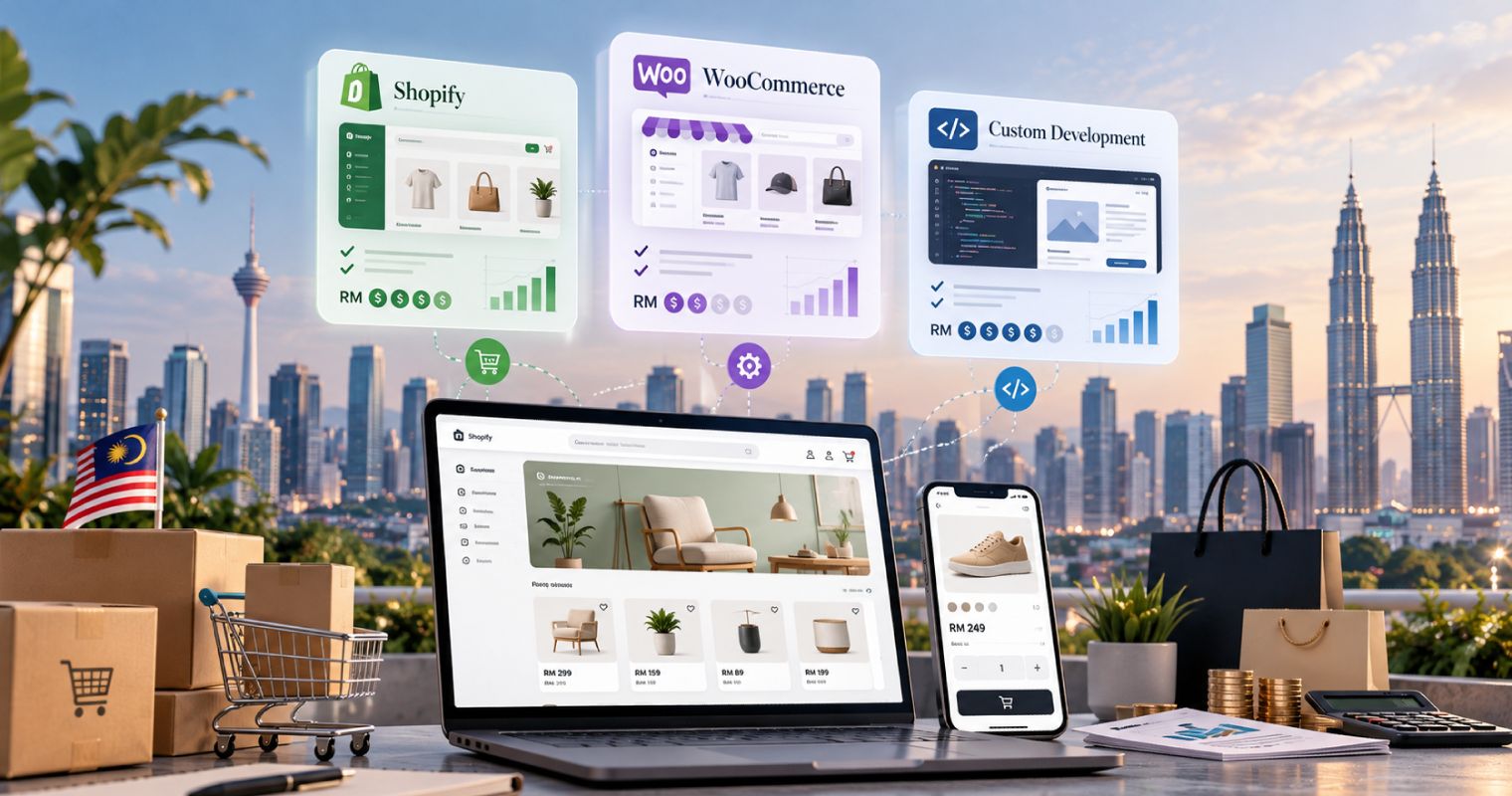
Search for “ecommerce website cost Malaysia” and you will find everything from RM2,000 packages to RM50,000-plus proposals. That does not necessarily mean one developer is cheap and another is overcharging. More often, they are selling completely different things under the same label: “ecommerce website.”
A template store with 20 products, one payment method and a standard checkout is not comparable with a bilingual store connected to an ERP, warehouse inventory, courier APIs, loyalty system and regional payment flows.
So, what should a Malaysian business realistically budget?
Based on published Malaysian agency pricing in 2026, a sensible planning range looks like this:
| Ecommerce project | Typical Malaysian planning range | Usually suitable for |
|---|---|---|
| Starter/template ecommerce store | RM3,000–RM6,000 | Microbusinesses, new brands, small catalogues |
| Professional SME ecommerce website | RM8,000–RM20,000 | Established SMEs, growing D2C brands |
| Advanced ecommerce implementation | RM15,000–RM35,000+ | Larger catalogues, custom UX, multiple integrations |
| Custom ecommerce platform | RM30,000–RM50,000+ | B2B, ERP/POS integration, custom workflows |
| Enterprise/custom web commerce system | Can move well beyond RM50,000 | Complex regional or operational requirements |
These are planning ranges, not an official Malaysian tariff. Recent published local pricing guides put starter stores around RM2,500–RM6,000, professional SME stores around RM8,000–RM20,000, and custom ecommerce platforms from roughly RM30,000–RM50,000 or more. Another Malaysian pricing analysis places SME ecommerce projects across a broader RM8,000–RM35,000 band, reflecting how much scope can vary.
Ara Semangat Asia’s own e-commerce website development page gives approximately RM6,000 as a baseline for a basic ecommerce website, while noting that hosting, domain, payment gateway and maintenance expenses may continue after launch.
That distinction matters. The development quotation is not your total ecommerce cost.
A serious ecommerce budget normally contains at least four layers:
Build cost covers UX, design, development, product configuration, payment setup and testing.
Platform and infrastructure cost covers Shopify subscriptions or, in the WooCommerce/custom world, hosting and server resources.
Transaction cost follows every sale through card processors, FPX, wallets or other payment providers.
Operating cost covers maintenance, applications, plugins, integrations, security, content, technical SEO and ongoing improvements.
This is particularly relevant in Malaysia because digital commerce is no longer a niche activity. The Department of Statistics Malaysia reported that ICT and ecommerce together contributed 23.5% of Malaysian GDP in 2025, equivalent to RM476.8 billion in gross value added. Ecommerce alone generated RM267.6 billion in gross value added, equivalent to 13.2% of the economy.
Consumer readiness is equally high. In 2025, 97.1% of Malaysian households had internet access, while individual internet use reached 98.3% and mobile-phone usage reached 99.6%. Urban household internet penetration stood at 99.0%, but even rural household access had reached 90.7%.
In other words, Malaysian customers are already online. The strategic question is no longer, “Do we need ecommerce?” For many businesses it is, “How much should we invest without overbuilding?”
And that is where choosing between Shopify, WooCommerce and custom development becomes important.
Shopify vs WooCommerce vs Custom: Ecommerce Website Cost Malaysia Comparison
At first glance, comparing the three platforms looks simple. Shopify has a subscription. WooCommerce is free. Custom development is expensive.
In practice, that is too simplistic.
WooCommerce software may be free, but servers, premium extensions, maintenance and development are not. Shopify removes much of the infrastructure burden, but Malaysian merchants need to pay particular attention to payment-provider transaction charges. Custom development costs more upfront but may save an organisation from forcing complicated business operations through dozens of plugins.
Here is a more useful comparison.
| Cost factor | Shopify | WooCommerce | Custom development |
|---|---|---|---|
| Typical initial Malaysian build | RM3,000–RM15,000+ | RM5,000–RM20,000+ | RM30,000–RM50,000+ |
| Core platform fee | Subscription | Free/open source | None unless proprietary stack/licence used |
| Hosting | Included | Separate | Separate |
| Payment processor fee | Yes | Yes | Yes |
| Additional platform transaction fee | Potentially yes in Malaysia | No WooCommerce revenue share | Depends on architecture |
| Apps/plugins | Often recurring monthly | Often annual licences | Usually functionality is developed/integrated |
| Technical maintenance | Relatively low | Moderate to high | Moderate to high |
| Infrastructure control | Limited/moderate | High | Very high |
| Ease of administration | High | Moderate | Depends on build |
| SEO flexibility | Good | Very high | Potentially very high |
| Complex ERP/POS workflows | Possible, but can become expensive | Strong with development | Strongest when properly engineered |
| Best fit | Speed and simplicity | SMEs wanting control/flexibility | Unique operational requirements |
The initial-build figures above are planning bands synthesized from current Malaysian published pricing rather than official fixed rates. Malaysian guides in 2026 put mainstream SME online stores broadly between RM8,000 and RM35,000, while more bespoke commerce or web-application projects start higher and can rise significantly once custom business logic is involved.
The most important takeaway is this:
Do not select your ecommerce platform by comparing only the development quotation. Compare the total cost of ownership over at least three years.
Suppose Company A is quoted RM7,000 for Shopify and Company B RM11,000 for WooCommerce. Shopify looks RM4,000 cheaper.
But what happens after launch?
If Company A pays Shopify subscription charges, several paid applications and an additional Shopify fee on transactions processed through a third-party payment gateway, while Company B pays hosting, plugin renewals and WooCommerce maintenance, the economics can change considerably as sales volume grows. Shopify confirms that its third-party provider fees are separate from the payment provider’s own processing charges. WooCommerce, by contrast, states that its core platform has no monthly subscription and takes 0% revenue share.
Custom development changes the equation again. Spending RM40,000 to avoid a RM100-a-month plugin clearly makes no sense. Spending RM40,000 to automate an operation that otherwise requires three employees to manually reconcile inventory, wholesale pricing and fulfilment every day may make excellent business sense.
This is why a good website design and development proposal should define business processes and integrations, not just show attractive homepage mock-ups. Ara Semangat Asia also notes that recurring domain, hosting and maintenance costs continue after a website is launched.
The cheapest website is not necessarily the website with the smallest invoice.
The cheapest website is the one that delivers the required commercial outcome with the lowest sensible total cost and risk.
Shopify Ecommerce Website Cost in Malaysia
Shopify is attractive for an obvious reason: it removes a great deal of technical responsibility from the merchant.
Hosting, the core commerce platform and much of the infrastructure are bundled into the service. Your team can manage products, promotions, inventory and orders without administering a WordPress server. For a Malaysian SME without an internal technical team, that convenience has real economic value.
As of October 2026, Shopify Malaysia pricing lists these annual-billing rates:
| Shopify plan | Official annual-billing price | Approx. RM equivalent* | Third-party provider fee |
|---|---|---|---|
| Basic | US$19/month | ~RM78/month | 2.0% |
| Grow | US$49/month | ~RM200/month | 1.0% |
| Advanced | US$299/month | ~RM1,221/month | 0.6% |
| Plus | From US$2,300/month | ~RM9,393/month | 0.2% |
*RM equivalents use Bank Negara Malaysia’s KL USD/MYR reference rate of 4.0841 on October 26, 2026 as a comparison benchmark. Shopify supports MYR local-currency billing for eligible Malaysian merchants on non-Plus plans, so the actual subscription shown in a merchant account can differ from simply converting the USD website price.
This is where Malaysia creates an important wrinkle.
Shopify Payments is not currently listed as available for Malaysia. Shopify’s official supported-country list includes markets such as Singapore but not Malaysia, and Shopify instructs businesses in countries outside the supported list to use a third-party payment provider.
That matters because Shopify charges an additional transaction fee when a third-party payment provider is used. Shopify’s current Malaysia pricing page lists 2% for Basic, 1% for Grow and 0.6% for Advanced. Shopify also confirms that this third-party transaction fee is separate from the payment provider’s own processing charges.
Consider an illustrative payment setup.
Stripe Malaysia pricing currently lists 3% + RM1 for a successful domestic card transaction, with another 1% for international cards and another 2% if currency conversion is required. Its published FPX rate is also 3% + RM1, while GrabPay is listed at 3%.
If an eligible Malaysian Shopify merchant were using a third-party processor whose domestic card pricing was 3% + RM1, the simplified economics on Shopify Basic would look approximately like this:
Payment provider: 3% + RM1
Shopify Basic third-party fee: 2%
Illustrative combined variable cost: around 5% + RM1 per domestic card transaction
On Grow, it would be approximately 4% + RM1 under the same assumptions, and on Advanced about 3.6% + RM1. These are illustrations, not universal quotations: gateway compatibility, commercial agreements, payment method, tax treatment and merchant eligibility can change the result.
This also produces an interesting result when comparing Basic and Grow.
The annual-billing subscription difference is US$30 per month, roughly RM122.50 using the October 26 BNM reference rate. Grow reduces the third-party fee by one percentage point. Purely mathematically, that percentage-point saving offsets the higher subscription at approximately RM12,250 in monthly third-party-processed GMV, before considering taxes, apps or the additional Grow features.
So a Malaysian store generating RM20,000 or RM50,000 every month should not automatically stay on Basic because “the subscription is cheaper.” Transaction economics can become more important than the headline subscription fee.
Shopify’s strengths remain compelling. It is fast to launch, operationally straightforward and well suited to businesses where the marketing team—not developers—needs to control daily ecommerce activity. Grow supports up to five staff accounts, while Advanced provides up to 15 and additional international and shipping capabilities.
There are, however, three costs businesses routinely underestimate.
First are applications. Reviews, loyalty, subscriptions, advanced filtering, upselling, sophisticated search, shipping or marketplace synchronization can introduce multiple recurring app subscriptions.
Second is development around the theme. Buying a Shopify theme does not automatically produce a differentiated customer experience. A serious brand may still need UX design, Liquid development, conversion optimization and structured content.
Third is international payment architecture. Shopify notes that stores using payment providers other than Shopify Payments or Adyen can display local currencies while the actual checkout payment may revert to the store’s default currency, depending on the configuration. That is worth investigating carefully for Malaysian businesses targeting Singapore, Indonesia, Australia, Europe or other cross-border markets.
For straightforward D2C commerce, Shopify can therefore be excellent value. Just do not mistake RM78-ish platform cost for the total cost of operating a Shopify business.
WooCommerce Ecommerce Website Cost in Malaysia
WooCommerce approaches the problem from the opposite direction.
Instead of renting a complete hosted commerce platform, you build on WordPress and control the hosting environment, theme, extensions and much more of the technology stack yourself.
WooCommerce’s official pricing guide states that the core platform is free and open source, with no monthly core subscription and 0% revenue share. WooCommerce estimates hosting for most stores at US$25–US$350 per month globally depending on performance and traffic requirements, while paid extensions commonly cost US$29–US$299 per year each.
Of course, “free software” does not mean “free ecommerce website.”
For a Malaysian SME, a more realistic WooCommerce planning model might look like this:
| WooCommerce cost | Practical Malaysian planning allowance |
|---|---|
| Initial store development | RM5,000–RM20,000+ |
| Domain | Around RM60–RM120/year |
| SME hosting | Roughly RM50–RM500/month, depending on resources/support |
| Premium plugins/extensions | RM500–RM3,000+/year |
| Technical maintenance | RM400–RM1,500+/month, depending on scope |
| Full ecommerce management/support | RM1,500–RM5,000+/month for heavier retainers |
| Payment processing | Per transaction |
The development and maintenance numbers are planning ranges built from Malaysian published prices rather than official WooCommerce fees. Ara Semangat Asia lists typical domain pricing of RM60–RM120 annually, while current Malaysian support offers range from roughly RM400 per month for defined WooCommerce maintenance to RM1,500–RM5,000 or more for more comprehensive ecommerce retainers.
Why can WooCommerce development cost more than a starter Shopify implementation?
Because someone has to assemble the machine.
The agency may be configuring the hosting stack, theme framework, caching, backups, security, payment integration, shipping rules, email delivery, product architecture, structured data and plugin compatibility. A store using 15 extensions also requires testing when WordPress, WooCommerce, PHP, the theme or one of those extensions changes.
That additional responsibility is the downside.
The upside is control.
For businesses investing heavily in search engine optimization, WooCommerce can be especially attractive because WordPress provides extensive control over information architecture, category content, editorial landing pages, internal linking and technical SEO configuration. Ara Semangat Asia’s ecommerce offering itself emphasizes WooCommerce development alongside an SEO-friendly structure and integration between ecommerce and digital marketing.
WooCommerce also has a useful economic advantage at higher sales volumes: the core platform does not take a percentage of merchant revenue. You still pay the payment processor, but WooCommerce says it adds no platform processing fee or revenue share of its own.
Imagine two stores each processing RM100,000 monthly through comparable third-party payment arrangements.
A Shopify Basic merchant facing Shopify’s 2% third-party fee could incur up to RM2,000 per month in Shopify transaction fees alone on that RM100,000, in addition to its payment processor charges, subject to Shopify’s applicable transaction-fee rules. A WooCommerce business does not owe WooCommerce an equivalent 2% revenue share.
That does not automatically make WooCommerce cheaper. Perhaps the WooCommerce business spends RM1,500 monthly on hosting, development support, monitoring and premium software. Perhaps Shopify eliminates enough technical work to justify its fee.
But this is exactly why ecommerce cost needs to be modeled against sales volume, not just setup cost.
WooCommerce tends to make the most sense when a business values content and SEO, needs greater technical ownership, wants freedom over hosting and integrations, already uses WordPress, or expects enough ecommerce volume that percentage-based platform charges become strategically important.
It is less attractive when nobody in the company wants responsibility for updates, security and technical maintenance.
A WooCommerce website left untouched for two years is not a low-cost website. It is deferred technical debt.
Custom Ecommerce Development Cost in Malaysia
“Custom ecommerce” is one of the most misunderstood phrases in web development.
Sometimes it means a developer changed the colors of a WooCommerce theme.
That is not what we mean here.
True custom development is appropriate when the ecommerce platform must adapt to business logic that Shopify or WooCommerce cannot support cleanly without increasingly fragile workarounds.
Recent Malaysian pricing guides put custom ecommerce platforms around RM30,000–RM50,000+, while broader custom web-application work can range from roughly RM15,000–RM60,000 and upward. More sophisticated ecommerce design and engineering scopes can exceed those figures substantially.
What pushes the project into this territory?
Imagine a Malaysian distributor selling the same products to consumers, dealers and corporate accounts. Retail customers see standard prices. Dealers receive one of four negotiated price tiers. Corporate customers require purchasing approval before an order is confirmed. Stock sits across Shah Alam, Penang and Johor Bahru. Website orders need to synchronize with ERP inventory, while Lazada, Shopee and physical POS sales must also reduce the same stock pool.
Now add customer-specific credit limits, quotation requests and regional subsidiaries.
At that point, the question is no longer, “Which Shopify theme looks nicer?”
It is an information-systems problem.
Custom development becomes reasonable for requirements such as ERP or accounting synchronization, multi-warehouse inventory, complex B2B price rules, dealer portals, approval workflows, unusual product configurators, marketplace synchronization, highly specialized subscriptions or bookings, proprietary loyalty rules, multi-brand architecture, or headless commerce where the commerce engine must feed multiple front ends.
The cost is not only coding. Discovery, system architecture, UI/UX, API development, database design, testing, security, documentation, deployment and post-launch support all contribute to the price.
This is also why a suspiciously low custom-development quotation deserves scrutiny.
If one proposal is RM12,000 and another RM50,000, ask whether both include the same things: staging environment, automated backups, API error handling, mobile QA, browser testing, transactional email, analytics events, migration, redirects, documentation, administrator training, source-code ownership and a warranty period.
Often, they do not.
Custom development also creates a maintenance obligation. Unlike Shopify, there is no platform vendor quietly managing the entire underlying SaaS infrastructure for you. Depending on complexity and service levels, current Malaysian ecommerce maintenance retainers can reach RM1,500–RM5,000 or more per month, with custom systems potentially requiring still more engineering support.
That sounds expensive until you compare it with the operational problem being solved.
Suppose custom integration removes 100 hours of manual order reconciliation each month. Or prevents repeated overselling between physical stores and ecommerce channels. Or makes dealer orders self-service rather than requiring a salesperson to prepare each quotation manually.
The right calculation is not:
“Is RM40,000 expensive for a website?”
It is:
“What business process does the RM40,000 system automate, and what is that worth over three to five years?”
There is another reason Malaysian companies should think this way: regional expansion.
Bank Negara Malaysia reported 18.4 billion e-payment transactions in 2025, up 25% year over year. Retail e-payment value rose to RM831 billion. Mobile banking accounted for 64% of online-banking activity, and active mobile-banking users reached 25 million. DuitNow QR transaction volume doubled to three billion, with almost three million registered QR touchpoints by the end of the year.
Cross-border infrastructure is evolving too. BNM is involved in Project Nexus, which is designed to improve interoperability between instant-payment systems across participating markets and make cross-border payments more like domestic payments in speed and usability.
For a business planning beyond Malaysia, this means the ecommerce architecture should be considered alongside currencies, payments, logistics, localisation and systems integration from the beginning—not bolted on after the domestic website becomes successful.
That does not mean every SME needs custom development.
Quite the opposite.
A common mistake is to spend RM50,000 solving problems that Shopify or WooCommerce already solve perfectly well. Custom software earns its premium only when the business genuinely has custom requirements.
Maintenance, Payment Fees and Hidden Ongoing Costs
Here is where many ecommerce website cost Malaysia comparisons go wrong.
A business asks three agencies:
“How much for an ecommerce website?”
Agency A says RM6,000.
Agency B says RM12,000.
Agency C says RM25,000.
The owner chooses RM6,000.
Twelve months later, the company discovers that hosting, plugin licences, product updates, gateway charges, security maintenance, content work and development changes were never included.
The original “cheapest” quotation may no longer be cheapest.
A more useful budget looks at the following recurring categories.
| Ongoing expense | Shopify | WooCommerce | Custom |
|---|---|---|---|
| Platform/hosting | Subscription | Hosting required | Hosting/cloud required |
| Domain | Annual | Annual | Annual |
| Apps/extensions | Often monthly | Often annual | APIs/SaaS may recur |
| Payment processing | Yes | Yes | Yes |
| Extra platform transaction fee | Relevant with third-party Shopify provider | No Woo revenue share | Depends on solution |
| Core security/infrastructure | Mostly platform-managed | Merchant/agency-managed | Development team-managed |
| Software updates | Core handled by Shopify; apps/theme still need attention | WordPress, Woo, theme and plugins | Framework/dependencies |
| Content/product support | Separate | Separate | Separate |
| Development retainer | Optional | Recommended for serious stores | Usually recommended |
Maintenance is particularly variable.
Current Malaysian published plans show just how different the word “maintenance” can be. One WooCommerce support package is advertised at RM400 per month and covers monitoring, backups, software updates and security checks. Other 2026 market guides place comprehensive ecommerce retainers at RM1,500–RM5,000+ per month when the provider is also responsible for deeper monitoring, product work, checkout testing and ongoing technical support.
Therefore, never compare maintenance prices without comparing the service-level agreement.
RM400 for scheduled updates and backups can be perfectly reasonable.
RM2,500 for a retainer that includes development hours, priority incident response, performance work, checkout QA, product changes and integration troubleshooting can also be perfectly reasonable.
They are different products.
Hosting has the same problem.
A small WooCommerce catalogue with modest traffic can operate on relatively inexpensive hosting. A store receiving thousands of concurrent visitors during a campaign, processing large numbers of orders and synchronizing external inventory needs considerably more infrastructure. WooCommerce’s own global cost guide puts hosting for most stores at US$25–US$350 monthly depending on traffic and performance.
Payment fees deserve even more attention because they scale with revenue.
Malaysia’s customers have become deeply accustomed to electronic payment. Bank Negara Malaysia says average e-payment usage reached 538 transactions per Malaysian in 2025, while FPX and DuitNow Online Banking/Wallet transactions are commonly used for ecommerce purchases.
A merchant should therefore model card, online-banking and wallet fees using the expected sales mix rather than asking only whether a gateway has “no setup fee.”
For example, Stripe’s standard Malaysian card rate is currently 3% + RM1 for domestic cards. At a RM50 average order value, the RM1 fixed element alone is equivalent to another 2% of the order. At RM500, it is only 0.2%. Transaction economics vary materially with average order value.
International commerce adds another layer. Stripe publishes a 1% additional charge for international cards and another 2% when currency conversion is required under its standard Malaysian card pricing.
So a Malaysian beauty brand selling RM80 products domestically has a different optimal payment-cost structure from a B2B manufacturer taking RM8,000 orders from Singapore.
Other commonly overlooked costs include product photography, copywriting, product uploads, bilingual or multilingual content, premium themes, abandoned-cart tools, reviews, loyalty systems, advanced search, email/SMS platforms, marketplace connectors, courier integrations, accounting integrations, analytics implementation, conversion-rate optimization and SEO.
SEO deserves particular attention because ecommerce sites can become technically messy very quickly. Product variants, filtered navigation, pagination, sold-out products, duplicate descriptions and category hierarchies all affect how search engines understand the store. Building an SEO-friendly structure at launch is generally more efficient than reconstructing it after hundreds or thousands of URLs have been indexed. Ara Semangat Asia’s ecommerce and SEO services both emphasize site structure, usability and search visibility as part of digital performance.
One more hidden cost is ownership.
Before signing any ecommerce contract, confirm who owns and controls the domain registrar account, hosting account, source code, design files, Shopify owner account, Google Analytics property, Google Search Console property, payment gateway, email system and third-party integrations.
The cost of changing suppliers becomes much higher when a former developer controls the infrastructure.
A simple procurement rule helps:
Ask every vendor for both the launch cost and the expected annual operating cost.
That single question makes ecommerce quotations dramatically easier to compare.
Which Ecommerce Platform Gives Malaysian SMEs the Best Value?
There is no universal winner between Shopify, WooCommerce and custom development.
There is, however, usually a correct answer for a particular business.
Choose Shopify when operational simplicity matters most. A small marketing or retail team can run the store without assuming responsibility for servers and WordPress maintenance. It is particularly attractive when speed to market, predictable infrastructure and an established application ecosystem matter more than deep platform control. Just model Malaysia’s third-party payment-provider fees carefully because Shopify Payments is not currently listed as available in the country.
Choose WooCommerce when you want flexibility, content depth and ownership. For many Malaysian SMEs, it offers an excellent middle ground: no core software subscription, no WooCommerce revenue share, strong WordPress content capabilities and broad freedom over hosting and integrations. The trade-off is that somebody competent has to maintain the system.
Choose custom development only when the business case requires it. ERP synchronization, unusual B2B workflows, multiple warehouses, dealer pricing, proprietary operational logic or regional system integration can justify the additional investment. A standard catalogue and checkout normally cannot.
For budgeting purposes, a Malaysian SME can start with this rule of thumb:
| Business situation | Sensible starting point |
|---|---|
| Testing a new ecommerce concept | RM3,000–RM6,000 starter build |
| Established SME selling seriously online | RM8,000–RM20,000 professional build |
| Strong brand requiring sophisticated UX/integrations | RM15,000–RM35,000+ |
| Ecommerce tied deeply to operations | RM30,000–RM50,000+ custom development |
| Complex multi-system or regional commerce | Scope individually; can exceed RM50,000 materially |
Those ranges are consistent with several current Malaysian published pricing guides, but the requirements—not the table—should determine the final budget.
The Malaysian market also argues strongly against treating ecommerce as a desktop website project. With individual mobile-phone usage at 99.6% and internet usage at 98.3% in 2025, the buying journey is overwhelmingly digital and highly mobile.
That means your budget should protect the areas customers actually experience: mobile speed, product discovery, payment choice, checkout clarity, trust signals, shipping information and post-purchase communication.
Meanwhile, Malaysia’s digital economy continues to expand. Ecommerce contributed RM267.6 billion in gross value added in 2025, while payment behavior is becoming increasingly digital and mobile. For SMEs, building an owned ecommerce channel is therefore not simply an IT purchase. It can become part of the company’s customer-data, brand, search, cross-border and margin strategy.
The best way to assess ecommerce website cost Malaysia is consequently not to ask, “How cheaply can we launch?”
Ask five better questions:
What do customers need to do on the website?
A simple catalogue has very different economics from a B2B ordering portal.
What systems must exchange data with it?
Payments and couriers are relatively standard; ERP, POS and multi-warehouse synchronization can change the entire scope.
What happens when monthly sales grow from RM10,000 to RM100,000?
At higher GMV, transaction percentages, infrastructure and operational automation become much more important.
Who will maintain the platform after launch?
A website without an ownership and maintenance plan is a future migration project waiting to happen.
Where will the company sell in three years?
Malaysia-only commerce is different from an ASEAN operation requiring localized content, currencies, payments, logistics and regional integrations. BNM’s continuing work on regional payment connectivity under initiatives such as Project Nexus illustrates the direction in which Southeast Asian digital payments are moving.
For most Malaysian SMEs, RM8,000–RM20,000 is a useful starting budget for a professionally implemented ecommerce store, with the final figure driven by design, catalogue complexity, integrations and content. A basic implementation can sit below that, while serious custom commerce can quickly exceed RM30,000–RM50,000.
Shopify usually wins on convenience. WooCommerce frequently wins on flexibility and control. Custom development wins when the business genuinely does something that standard platforms cannot accommodate efficiently.
But whichever route you choose, judge the investment on three-year total cost and commercial value—not the day-one quotation.
For businesses evaluating the next step, Ara Semangat Asia’s e-commerce website development services combine ecommerce implementation with responsive design, WooCommerce capability and an SEO-conscious approach rather than treating development and digital marketing as separate projects.
For broader context on Malaysia’s digital-commerce environment, see the Department of Statistics Malaysia’s ICT Satellite Account 2025 and Bank Negara Malaysia’s 2025 payments review. Together, the data tell a straightforward story: Malaysian consumers and businesses are already deeply digital. The real competitive advantage now comes from building the right ecommerce infrastructure at the right cost.