
Your CPC rises. Your dashboard still looks “fine.” Your sales team says the leads are weaker. Sound familiar?
That is the modern paid media problem in one line: most businesses do not have a traffic problem anymore. They have an allocation problem. Budget gets pushed too hard into the channel with the cleanest-looking last-click report, while the channels creating demand get underfunded, misread, or cut too early. The result is predictable: search gets blamed for getting expensive, social gets blamed for being “just awareness,” and nobody can explain why the best customer journey started with a scroll, continued with a brand search, and ended with a WhatsApp click or direct inquiry a few days later.
In Malaysia, that tension is sharper because the market is deeply digital and heavily mobile. At the start of 2025, the country had 34.9 million internet users, 25.1 million active social media user identities, and 43.3 million cellular mobile connections. Median mobile internet download speed reached 104.99 Mbps, which means consumers can move between video, search, marketplace browsing, and direct messaging with very little friction. This is not a single-channel environment. It is a fast-switching one.
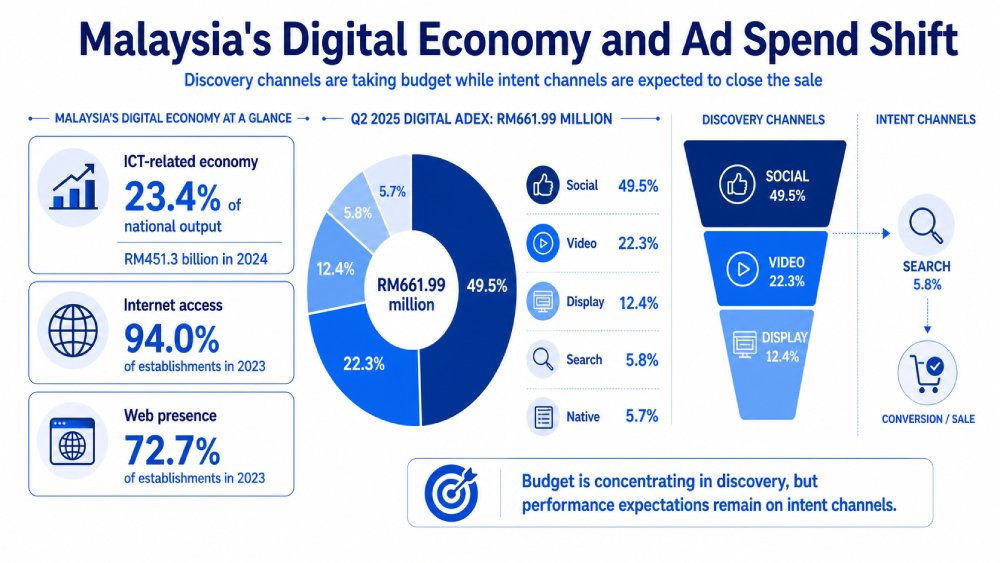
The money is following that behavior. Malaysia’s ICT-related economy contributed 23.4% of national output in 2024, or RM451.3 billion, while 94.0% of establishments had internet access and 72.7% had a web presence in 2023. The official digital advertising market data also shows how skewed the media mix has become: in Q2 2025, total Malaysian digital adex reached RM661.99 million, with social taking 49.5% of reported spend, video 22.3%, display 12.4%, search 5.8%, and native 5.7%. In other words, discovery channels are swallowing budget, while intent channels are still expected to close the sale.
The commercial backdrop makes this even more urgent. Malaysia’s digital economy was projected to hit US$31 billion in gross merchandise value in 2024, up 16% year over year. E-commerce remained the largest contributor at US$16 billion, while online travel was forecast to reach US$8 billion and food delivery plus transport US$4 billion. For SMEs, hotels, retailers, clinics, education brands, and exporters, that means more digital demand is available—but also more fragmentation, more auction pressure, and more wasted spend if the channel mix is managed by feel alone.
This is exactly where multi channel ad budget optimization matters. The job is not to make every platform look equally efficient. It is to make the total system produce more profitable demand. That is a different mindset.
It is also why AI PPC budgeting Malaysia is becoming such a practical issue rather than a trendy one. You need leads now. You need less waste. And you need a way to see how channels help each other instead of fighting over credit.
What multi-channel advertising and adset budget optimization actually mean
Multi-channel advertising is simple in definition and messy in real life. It means running coordinated campaigns across more than one paid channel—usually search, social, video, display, retargeting, and sometimes marketplaces or lead-gen formats—so each channel plays a role in one conversion path rather than acting like a separate silo. A buyer may discover you on short-form video, research you on Google, revisit through remarketing, and finally convert through a form, a call, or a WhatsApp message.
That distinction matters because too many teams still confuse “multi-channel” with “same ad, same budget, everywhere.” That is not strategy. That is duplication. Real multi channel ad budget optimization assigns a job to each channel. Search captures active demand. Social and video create or shape demand. Retargeting shortens hesitation. Creative testing finds what stops the scroll. Owned channels like email or CRM follow-up recover what paid media started.
For many local SMEs, that final conversion is not a fancy ecommerce checkout. It is a human hand-raise. ASC Group Asia’s own PPC lead generation guide frames leads in very practical Malaysian terms: a form inquiry, a phone call, a free consultation request, a direct message, or a click on the WhatsApp button. That is important because machine learning ad spend allocation only works well when the conversion event reflects actual business value. If you optimize to traffic when the real win is a WhatsApp inquiry, the algorithm will gladly buy you cheap clicks and expensive disappointment.
Ad set budget optimization sits one level lower. It refers to how you control spend inside a campaign. On platforms such as Meta and TikTok, you can either set budget at the campaign level and let the platform distribute spend across ad sets, or force a budget at the ad-set level when you need tighter control by audience, geography, funnel stage, or offer. Meta’s campaign budget system continuously distributes budget in real time to the ad sets with the best opportunities, while TikTok’s Campaign Budget Optimization uses one unified campaign budget shared across ad groups to maximize conversion volume at campaign level rather than ad-group level.
So when should you use campaign-level automation, and when should you not? Use campaign-level budgeting when the objective is the same, the conversion event is the same, and the ad sets are close substitutes for each other. Do not use it when you must ring-fence spend by market, margin profile, language, or funnel stage. If one ad set is Malaysia B2B leads and another is broader regional awareness, they should not fight in the same optimization bucket. AI is fast, but it is not clairvoyant. It still optimizes toward the target you gave it.
A practical example helps. Imagine a hospitality brand selling weekend stays, event packages, and wedding inquiries. A strong multi-channel strategy would use short-form video to create aspiration, branded and non-branded search to capture active planners, dynamic remarketing to revisit site visitors, and click-to-message ads to catch prospects who want quick answers on availability or packages. The channels do different work. The budget should reflect that. Not evenly. Intelligently.
If your team needs a simple planning shortcut, use a practical 3-3-3 rule: three core messages, three audience groups, and three priority channels. For example, message one could be price and availability, message two social proof, message three urgency. Audience one could be cold prospects, audience two recent site visitors, audience three qualified returners. Channels one, two, and three might be search, social video, and remarketing. Simple beats scattered.
AI PPC budgeting Malaysia starts with the local numbers
The strongest AI model in the world will still make weak decisions if your local economics are misunderstood. That is why AI PPC budgeting Malaysia should begin with market reality, not platform hype.
The reach is there. Official platform audience estimates compiled in the latest digital country data show that Malaysia had 25.1 million YouTube users in early 2025, 23.1 million Facebook users, 15.5 million Instagram users, 19.3 million TikTok users aged 18 and above, and 9.10 million LinkedIn members. That matters because a good budget model must reflect where intent and attention live for your category. Broad B2C brands still cannot ignore Facebook and YouTube. Visually driven products still need Instagram and TikTok. Higher-consideration B2B campaigns may still find useful scale through search, video education, and professional audience layers.
The regional context is just as important for businesses selling across borders. Across Southeast Asia, the digital economy grew from US$40 billion in GMV a decade ago to over US$300 billion in 2025. Three in five people now shop online, and more than 60% of transactions are digital. In the 2024 regional report cycle, video commerce already represented 20% of ecommerce GMV in the region, more than four times its 2022 level, while up to 65% of consumers were participating in the digital economy. Existing online shoppers, not just first-time ones, were the main growth driver.
That last point changes how budget should be allocated. If video commerce is growing and returning buyers are driving more of the expansion, then a budget model that overweights last-click search is too narrow. Search is still critical, especially when someone is ready to book, buy, compare, or ask for a quote. But if the consumer was persuaded three days earlier by short-form video, creator content, or retargeted social proof, then cutting those upper- and mid-funnel touchpoints can quietly make search look worse and more expensive over time.
Now for the uncomfortable benchmark truth: local channel benchmarks are still thinner than most SMEs would like, so teams often import global PPC averages and misuse them. As a directional reference, WordStream’s 2025 study of more than 16,000 search ad campaigns reported an average CTR of 6.66%, average CPC of US$5.26, average conversion rate of 7.52%, and average cost per lead of US$70.11 across industries.
Those figures are not Malaysian benchmarks, and they should never be treated as such. But they are useful as smoke alarms. If your search CTR, CPC, or conversion rate is far outside both global directional norms and your own historical baselines, something usually needs diagnosing.
The more relevant benchmark for Malaysia is not one imported CPC chart. It is the relationship between local digital behavior and channel role. Social already dominates reported ad spend. Video commerce is rising regionally. Mobile access is near-universal. Establishments’ web presence is improving but still not universal.
Taken together, that tells you something very practical: many Malaysian businesses are still underbuilt on conversion infrastructure while overexposed to paid traffic. AI can improve allocation, yes. But if your landing page is slow, your form is clumsy, or your WhatsApp response time is poor, the algorithm will only accelerate inefficiency.
This is where local nuance beats generic advice. A café brand with low-ticket repeat purchases may accept softer first-touch ROAS from social if it builds cheaper remarketing pools and stronger branded search. A boutique hotel may accept high meta-search or search CPCs if direct bookings reduce OTA dependence.
An education provider may pay more for lead quality but only if offline closing data is fed back into the ad platforms. Same concept. Different economics. That is why machine learning ad spend allocation works best when you define value with brutal honesty.
How machine learning ad spend allocation works in the real world
The biggest automation stacks today come from Google, Meta, TikTok, and Microsoft. They all promise “better results.” The real question is what they are actually optimizing, how much control you still keep, and where each system becomes useful.
Start with Google Ads, because this is still where high-intent demand often gets priced. Smart Bidding is a set of automated bidding strategies that uses Google AI to optimize for conversions or conversion value. It sets bids at auction time, not just a few times per day, and takes into account a wide set of contextual signals such as device, location, time of day, browser, operating system, language, and query-level performance modeling. For search advertisers, that matters because manual bid logic simply cannot react with the same granularity at scale.
The measurement layer matters just as much. Google’s data-driven attribution distributes conversion credit based on how people interact with ads across Search, Shopping, YouTube, Display, and Demand Gen. In Google Analytics, the data-driven model uses path data and assigns fractional credit according to how each touchpoint changes the probability of a key event. This is one of the clearest examples of machine learning ad spend allocation in practice: you stop treating the last click as the whole story and start funding the touchpoints that actually raise conversion likelihood.
Budget controls inside Google are also getting smarter. Shared budgets automatically reallocate underused budget to campaigns that are capped by budget, and Google says it is best practice to pair shared budgets with portfolio bid strategies for campaigns with the same goals. In one Google help document, customers adopting Shared Budgets and Portfolio Bid Strategies on Search campaigns were said to experience about 13% more conversions on average.
On top of that, budget pacing insights show current and projected monthly spend and forecasted goals, while the Recommended Investment Strategy suggests how extra budget could be distributed across campaigns to maximize clicks, conversions, or conversion value.
For larger or more mature advertisers, Google is now extending that logic into planning tools. The GA4 cross-channel budgeting beta lets teams build projection plans and scenario plans to understand ROI at different spend levels, but it requires at least one year of eligible web conversion data and does not yet support app conversions. That is a major clue for SMEs: if your account is still thin on clean data, platform-native AI can still help with bidding, but full cross-channel budget forecasting will remain limited until your measurement history matures.
At the next level up sits Meridian, Google’s open-source marketing mix model. Google describes it as an open-source MMM built for today’s consumer journeys, designed to help marketers make smarter decisions when measuring outcomes across channels. It emphasizes transparency, richer data, and budget optimization. For cross-border brands spending across multiple countries, this is where the conversation moves from “which campaign gets another RM500 tomorrow?” to “which channel-country mix creates the highest return this quarter?”
Meta’s budget logic is slightly different but philosophically similar. Campaign budgets on Meta can automatically distribute spend across ad sets in real time to the ad sets with the best opportunities. Meta also says multiple placements can increase the number of people who see your ad and can improve results, and one official placement experiment reported that ad sets using Advantage+ placement delivered an average 11.7% lower cost per action than ad sets using manual placement. Translation: if your account structure is clean and your signal quality is decent, overcontrolling placements and micro-budgets can actually make performance worse.
That does not mean “hands off everything.” Meta’s own bid-cap guidance is clear that bid cap is meant for advertisers who understand how their maximum bid corresponds to outcomes. Budget scheduling can also be useful when you know better opportunities exist at certain times, because it lets you schedule budget increases at the campaign or ad-set level for days or times when you expect stronger results.
For Malaysian businesses, that can be practical around promotional windows, holiday periods, school breaks, or weekly demand spikes—assuming you have the data to justify the schedule. Beginners should not rush into hard cost controls just because they look sophisticated.
TikTok has become more serious about performance budgeting too. Its Campaign Budget Optimization tool uses one unified budget across ad groups, and TikTok’s own setup guidance says advertisers should keep at least 3–5 unique active ad groups per campaign, 2–3 unique creatives per group, and avoid major changes until at least three days have passed or 50 conversions have been recorded.
TikTok also recommends limiting budget changes to 30% of the current daily budget during optimization, and its budget help documentation says campaign-level daily budgets must exceed US$50 while ad-group daily budgets must exceed US$20. These are not just platform footnotes; they are practical guardrails that stop teams from repeatedly resetting the learning phase.
TikTok’s newer Smart+ stack goes even further. The platform says Smart+ can automate targeting, creative, placement, and budget, and it can optimize campaign budget with automated CBO or advertiser-set budgets and bid strategies. For catalog-led commerce campaigns, TikTok reported a 36% drop in CPA versus manual campaigns in closed beta tests. Treat that as platform-reported upside, not a universal promise. But the operational lesson is sound: TikTok no longer belongs only in the “cheap awareness” box. In the right account, it can be a genuine performance input.
Microsoft Advertising is sometimes overlooked, which is precisely why it can matter. Its automated bidding tools are designed to be real-time and auction-level, with options for impression share, CPA, ROAS, click volume, and conversion volume goals. For certain B2B, desktop-heavy, or older-skewing demand pockets, Microsoft can offer a useful pressure valve when Google auctions become overly inflated. Smart multichannel budgeting is not loyal to logos. It is loyal to marginal efficiency.
The pattern across all of these systems is straightforward: the AI is strongest when the objective is clear, the conversion data is trustworthy, the campaign structure is not fragmented beyond reason, and the team gives the model enough room to learn. The AI is weakest when people feed it vanity metrics, panic-edit budgets every day, or ask it to “maximize everything” at once. Cheap clicks are not the goal. Profitable movement is.
How to balance CPC budgets across channels without choking growth
If you want to balance CPC budgets across channels properly, stop comparing channels by CPC first. Compare them by marginal business value.
A click from search often costs more because the user is further down the funnel. A click from social may cost less but require two or three more touches before it pays back. If you cut channels based on CPC alone, you usually overfund the cheapest traffic and starve the traffic that actually creates demand. The better comparison is cost per qualified action, cost per incremental visit from the right audience, cost per sales conversation, or revenue per thousand impressions if you have enough data. This is the real heart of multi channel ad budget optimization.
The most reliable way to do that is to assign conversion value ladders. For a lead-gen SME, a brochure download might be worth less than a WhatsApp click, which might be worth less than a qualified form fill, which is still worth less than a booked consultation. For ecommerce, a first purchase, repeat purchase likelihood, AOV, refund rate, and gross margin all matter. For hotels, a direct booking lead is worth more than a marketplace-assisted view if commission savings are meaningful. You do not need perfect attribution on day one. You just need value signals that are less naive than “all conversions count the same.”
Here is the practical operating model I recommend.
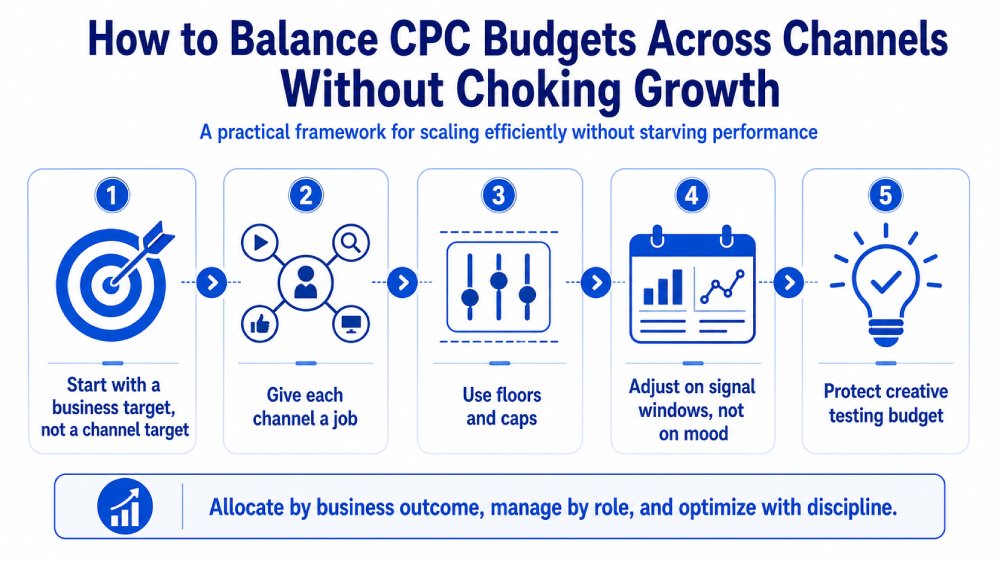
Start with a business target, not a channel target
For ecommerce, calculate break-even ROAS from contribution margin. If contribution margin after shipping, payment fees, and fulfillment is 30%, break-even ROAS is roughly 3.33. If you want profit, your working target needs to sit above that. For lead generation, start with:
maximum CPL = average first-sale gross profit × close rate × acceptable acquisition share
If a customer is worth RM2,000 in gross profit, your close rate is 20%, and you can afford to spend 25% of gross profit on acquisition, your max CPL is RM100. That one number instantly sharpens budget decisions across channels.
Give each channel a job
Search captures urgency. Social and video shape preference. Remarketing closes hesitation. Marketplace ads support product discovery. Direct messaging ads collect low-friction intent. If you do not define the role, the reporting will define it for you, and reporting tends to favor the channel closest to the final click.
Use floors and caps
Early-stage accounts should not let any one platform monopolize budget simply because it had a good weekend. Put a floor under channels that generate new demand, and a cap on channels that are harvesting branded or bottom-funnel traffic too aggressively.
A practical structure for many SMEs is a core-growth-test split: 60% core capture and close, 30% demand creation and nurturing, 10% testing. Mature accounts may move to 50/35/15. Aggressive launch accounts may go 40/40/20. The point is not the exact ratio. The point is controlled elasticity.
Adjust on signal windows, not on mood
TikTok says wait at least three days or 50 conversions before meaningful optimization changes in CBO campaigns, and recommends modest budget increases rather than violent ones. That principle extends beyond TikTok. Give algorithms room to stabilize. If you touch bid strategy, creative, audience, and budget all at once, you are not optimizing. You are scrambling.
Protect creative testing budget
A lot of “budget optimization” problems are actually creative depletion problems. Search can survive mediocre creative longer because intent is already present. Social cannot. If your top-funnel channels are weak at stopping the scroll, they never build qualified retargeting pools, which then makes search look like the only performer.
Keep a ring-fenced test budget for new hooks, formats, offers, and landing page angles. AI can route spend toward winners, but it still needs new options to choose from.
The mistakes that quietly drain spend
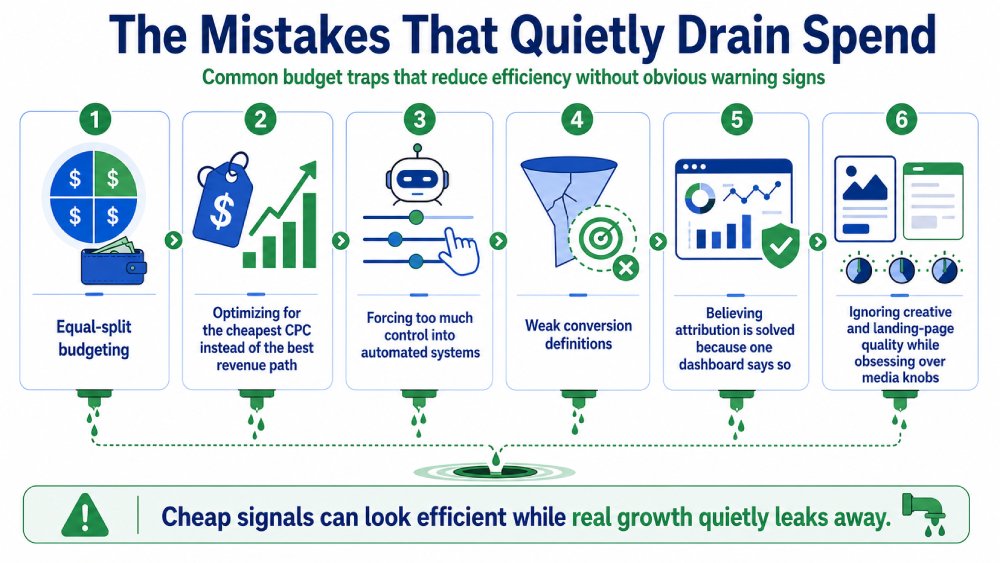
Equal-split budgeting
It feels fair, organized, and easy to explain. It is also usually wrong. Channels do not have equal jobs, equal saturation points, or equal economics. If you spread budget evenly across search, video, social, and remarketing because “that feels balanced,” you can end up starving the channels that need depth and overfeeding the ones that should stay opportunistic.
Optimizing for the cheapest CPC instead of the best revenue path
This is how teams end up celebrating low-cost traffic that never turns into booked calls, qualified leads, or profitable orders. Cheap clicks can be useful. Cheap clicks without intent are a vanity metric.
Forcing too much control into automated systems
Hard bid caps, oversegmented ad sets, tiny budgets, daily edits, and fragmented campaign structures can keep the model stuck in low-confidence learning. Meta explicitly warns that certain cost controls are for advertisers who understand the relationship between bids and outcomes, while TikTok’s guidance is clear that significant adjustments should be limited and spaced out. If you want AI to work, you have to stop interrupting it every 24 hours.
Weak conversion definitions
If a Malaysian SME optimizes only for pageviews when the real commercial intent shows up in WhatsApp, calls, catalog opens, route clicks, or lead quality after manual screening, the algorithm is being trained on the wrong target. That is not an AI issue. That is a business instrumentation issue. Fix the signal first.
Believing attribution is solved because one dashboard says so
Google’s own data-driven attribution and GA4 methodology both emphasize that different touchpoints change conversion probability across a path. That should humble anyone still cutting discovery channels just because they are not last-click heroes. Attribution is a model. Not divine truth. Use it to inform distribution, not to flatter one platform.
Ignoring creative and landing-page quality while obsessing over media knobs
AI cannot rescue an offer nobody wants, a page that loads slowly, or a message mismatch between ad and destination. It can only scale what is already directionally working. If your creative does not stop the scroll and your page does not continue the story, the budget model will eventually reflect that failure, no matter how advanced the bidding system sounds.
Conclusion
The old way of budgeting treated paid media like a row of separate buckets. Search here. Social there. Video somewhere else. In 2026, that is too slow and too blunt.
Multi channel ad budget optimization now means understanding the whole path to revenue, then letting automation handle the micro-decisions inside well-defined guardrails. That is what AI PPC budgeting Malaysia should look like in practice: clean conversion tracking, realistic business targets, channel-specific roles, smarter attribution, and machine learning ad spend allocation that is tied to actual commercial value.
When you do that well, you can balance CPC budgets across channels without starving awareness, overspending on branded intent, or panicking every time a dashboard swing appears.
The businesses that win this year will not necessarily be the ones with the biggest budget. They will be the ones that stop treating channels like silos, stop rewarding cheap noise, and start funding the full buyer journey with discipline.
That is how wasted spend drops. That is how more of the right prospects convert. And that is how a smarter budget becomes a growth system instead of a monthly guessing game.